
Native ads
Sponsored content cards that match the look of the publisher page and carry a clear sponsored label. Readers expect to read, so native advertising suits guides, comparisons and offers that need explanation.
Run native, display, retargeting and newsletter ads on partner publisher websites. Choose countries and devices, set a daily budget and pay per click.
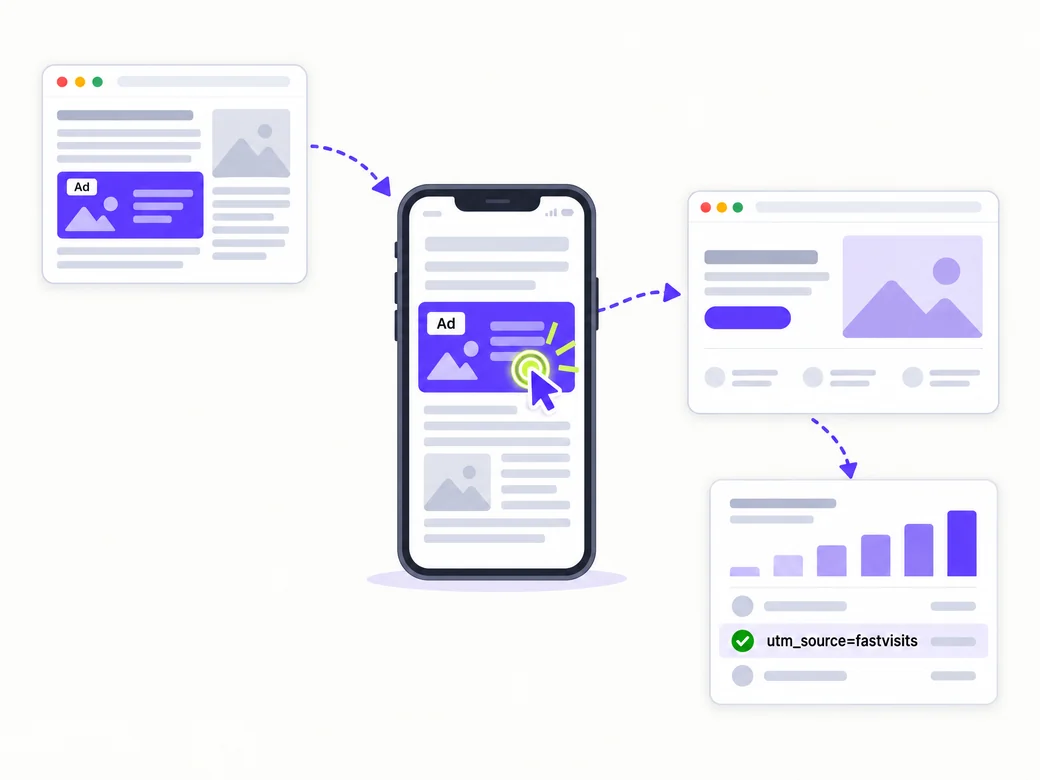
Advertising a website online often means a choice between two hard options. The large ad platforms are crowded and costly for a small test. Many smaller networks never say where your ads appear or what counts as a click, so you cannot judge whether a campaign worked.
The audience is not the problem. The World Bank estimates that 73.6% of the world's population used the internet in 2025, so the people you want to reach read websites and newsletters in every market you serve. The problem is reaching them on pages they trust, and paying only when one of them shows interest.
Here is how the gap costs money. A store owner pays a flat fee for a banner, sees no orders and cannot tell whether the banner ran on the wrong sites or simply failed to interest anyone. Weeks go into page changes that fix nothing, because the owner never saw where the ad appeared.
FastVisits is a pay-per-click (PPC) ad network operated by Nomad Minds FZCO in Dubai. Pay-per-click means you pay only when a person clicks your ad. We place your native, display, retargeting and newsletter ads on partner publisher sites, a person who finds the ad interesting chooses to click it, and they arrive on the page you selected.
On a partner publisher site or newsletter, in the countries you chose.
Your ad appears next to the content on a partner site or newsletter, labelled as sponsored.
The page you selected, on the device type you target.
With the FastVisits source label, so you can compare us with every other channel.
The source label is the part that protects your budget. You judge clicks from our ads on the same screen and under the same rules as your other channels. An ad network that cannot show where a click came from gives you a number, but no way to test it.
An ad format decides where people meet your ad and what they expect when they click. A banner on a news page, a sponsored card under an article and a link in a newsletter reach people in different moods, so each one suits a different page.
Sponsored content cards that match the look of the publisher page and carry a clear sponsored label. Readers expect to read, so native advertising suits guides, comparisons and offers that need explanation.
Banners in standard sizes on publisher pages. People often meet your brand for the first time, so display advertising suits clear offers, launches and landing-page tests.
Ads shown again to people who already visited your site. They know your brand, so retargeting suits reminders, offers and unfinished sign-ups.
An ad or a sponsored mention in a partner newsletter. Readers chose to receive it and trust the sender, so newsletter placements suit software trials and lead pages.
Any format can run on phones only. People on a phone have little time, so mobile advertising suits fast pages that ask for one short action.
The reader's mindset at the click decides how much of your page they read. Display suits quick offer tests, native and newsletter suit pages that need reading time, and the ad formats overview compares them in detail.
Advertising terms are often scattered. One network shows its rates only after signup, and another explains its review rules only when an ad is rejected. An advertiser who meets that once expects surprises everywhere, and many leave before they start.
We keep the terms in one place, so you know each step before you create your account.
Clear terms are easier to judge, and an advertiser who knows the next step is more likely to take it. A small first campaign on your own page is also the safest way to judge any new ad channel, because you decide with your own data.
You start with the website you want to advertise, then complete your account details.
You add a headline, a short text and an image where the format uses one, and you choose the page to promote.
Country or region, device, and topic where the format allows, plus the most you want to spend each day.
The check against our content rules usually takes up to one business day.
Each click carries our source label, so you can follow the results in your analytics and change the campaign at any time.
Long targeting lists are easy to write and hard to trust. A Canadian store that pays for clicks from countries it cannot ship to pays for interest it can never serve. A list of hundreds of niches does not help if nobody explains how each one is matched.
We list what you can target and what you cannot, because stated limits make the stated options believable.
Your daily budget sets the pace. It is the most you want to spend on clicks in one day, so a test stays within your plan. You can lower it during a busy week and raise it when your team is ready for more enquiries.
Clicks from outside your selected countries or devices are not billed. The geo-targeted ads page explains how to plan each market, and the regional pages below cover local languages and consent rules.
Campaigns for audiences in the United States and Canada, planned by country and region.
Market detailsMarket 02 / UK and IrelandCampaigns for the United Kingdom and Ireland, with local consent rules in mind.
Market detailsMarket 03 / EuropeCampaigns for European countries, planned by language and consent rules.
Market detailsMarket 04 / Asia-PacificCampaigns for Australia, New Zealand, Singapore, India and Southeast Asia.
Market detailsMarket 05 / Latin AmericaCampaigns for Latin American countries, planned by language and country.
Market detailsMarket 06 / UAE and GCCCampaigns for Dubai, the wider UAE, Saudi Arabia and the other Gulf states.
Market detailsMost ad networks say their clicks appear in your analytics. The promise is easy to make and hard to check. If your account reports 540 clicks and your analytics shows 478 sessions, you need a way to tell whether clicks were lost, filtered or never happened.
Several normal causes create this gap. Some people decline the cookie banner, and some use ad blockers that also block tracking code. Others close the page before the code loads, and a redirect can drop the label from the link.
We add a source label to every ad link, for example utm_source=fastvisits and utm_medium=native. A UTM parameter is a short tag at the end of a link that tells your analytics tool where a visit came from. With these tags, clicks from our ads stay separate from every other channel.
| Day | Format | Impressions | Clicks | Click-through rate | Sessions in your analytics |
|---|---|---|---|---|---|
| Day 1 | Native | 48,000 | 240 | 0.50% | 214 |
| Day 2 | Display | 61,000 | 183 | 0.30% | 160 |
| Day 3 | Newsletter | 9,000 | 117 | 1.30% | 104 |
| Total | Three formats | 118,000 | 540 | 0.46% | 478 |
Your account shows impressions (how often your ad was shown), clicks, click-through rate (clicks divided by impressions) and spend, by day and by format. You can compare those figures with the labelled sessions in your analytics, line by line.
When your analytics records more than 20% fewer labelled sessions than the clicks we report, and the normal causes above do not explain the gap, we review the campaign within two business days and add replacement clicks. The campaign reporting page describes each report field, and the guide to why clicks and sessions differ shows a full reconciliation.
An advertiser trying a new network wants to know three things first. How are ads reviewed, where do they appear, and how is billing counted? Clear written rules answer those questions before the first campaign starts.
Consider a software company that sees one campaign reach its pricing page less often than another. With source labels and a written review process, the team can compare placements and adjust the ad or the targeting within days.
We check every ad and destination page against our ad content rules before the campaign runs, usually within one business day.
Native ads appear on partner publisher websites and newsletters, labelled as sponsored or advertising.
Clicks from outside your selected countries or devices are not billed.
A gap above 20% between our click count and your labelled sessions, not explained by normal causes, is reviewed within two business days.
Written rules make a first campaign easier to plan. They also give you and us the same reference when a report differs from your analytics. Our placement standards page lists each rule.
A flat fee makes you pay for exposure before you know whether anyone cares. You pay per click, and nothing else. The per-click rate depends on the ad format, the market and the device you choose, and you set a daily budget that you can pause or change at any time.
The rate for your ad format and market is shown in your account before you pay. Prices are in US dollars and exclude local taxes. Billing terms are confirmed in your account before you pay.
| Ad format | Worldwide | United States | United Kingdom | Europe | UAE | GCC |
|---|---|---|---|---|---|---|
| Native adsSponsored content cards on publisher pages | On request | On request | On request | On request | On request | On request |
| Display bannersStandard banner sizes on publisher pages | On request | On request | On request | On request | On request | On request |
| Retargeting adsAds shown again to people who visited your site | On request | On request | On request | On request | On request | On request |
| Newsletter placementsSponsored spots in partner newsletters | On request | On request | On request | On request | On request | On request |
Rates apply to all devices unless a device rate is shown. Clicks from outside your selected countries or devices are not billed.
Create an advertiser accountCreate an advertiser account to set up your first campaign.
A cost per click (CPC) is the price of one click on your ad. Your spend for a day equals the clicks your ads receive multiplied by the per-click rate, within the daily budget you set. Rates differ by format and market, because space on some publishers and in some countries costs more than in others.
For example, suppose you pay $0.40 per click (a hypothetical rate, not a FastVisits rate) and set a hypothetical daily budget of $20. Your ads can then receive up to 50 clicks that day. The full pricing page explains each rate and includes a break-even calculator for your own numbers.
Many ad networks say they cannot guarantee sales and stop there. That statement is true, but it leaves you without a number to plan with. An advertiser who expects 50 orders from 500 clicks to a new store will judge any test a failure, even when the result is normal for the offer.
A break-even check takes a minute and sets the right expectation. Conversion rate is the share of people who take the action you want after they click, such as a purchase or a sign-up. Your maximum cost per click equals your conversion rate multiplied by your profit per sale.
Hypothetical maximum cost per click: 2 in every 100 people who click buy (2%), and each sale earns a hypothetical $40 profit.
Clicks needed for one sale at a 2% conversion rate: 1 divided by 0.02.
Clicks needed for 10 sign-ups at a 2% conversion rate: the target actions divided by the conversion rate.
The same check warns you early. If a page converts 1 in 200 people who click (0.5%), the maximum cost per click at the same hypothetical profit is $0.20. When the per-click rate for your market is higher than that, the page needs work before any ad campaign can pay back, and our guide to your maximum cost per click includes a worksheet for the full calculation.
Many first campaigns fail before the first click. A business sends ad clicks to a homepage with five offers, a slow mobile layout and no tracking on the thank-you page. People arrive, a few look around, and the owner cannot tell which part failed.
The page decides most of the result, so a short check before your first campaign pays for itself. These six points come from the questions we ask before every campaign.
A page with one clear action gives people one decision to make and gives you one number to measure.
Many people click ads on a phone, and a slow page loses them before the offer appears.
A test purchase or test sign-up confirms that your analytics records the action you care about.
People who click an ad decide quickly, so the main facts belong where they land.
When the page repeats the promise of the ad, the reader knows they reached the right place.
Clear words about the offer, the price and the next step convert better than keyword-heavy text, because the reader is a person with limited time.
The people who click have limited time, and a page that respects that time does more for your results than a bigger budget.
Pay-per-click advertising is one way to bring people to your website, and it works best next to the others. A business that relies only on ads loses that reach the day it stops paying. A business that relies only on search may wait months to learn whether an offer works at all.
Improving pages so they appear for the searches your buyers make. It builds lasting visibility, and results usually take months.
Guides and answers that people search for and share. It reaches people who arrive with a question you can answer.
Posts and communities on social platforms. It builds attention and trust, with a reach that depends on each platform's rules.
Messages to people who asked to hear from you. It often converts best, because the readers already know you.
Ads shown next to search results. People arrive with clear intent, at a price per click set by auction.
Ads on partner publisher sites and newsletters, which is what FastVisits provides. Campaigns run soon after the ad review, so they suit tests and launches.
Publisher ads make sense when you need answers quickly: testing a new landing page, launching a product or entering a new country. The guide on how to bring more people to your website compares every channel in more depth.
Shortcuts that skip the page work rarely pay back. When ad clicks bring no sales, the cause is usually the offer or the page, and the checklist on what to check when ad clicks bring no sales puts the possible causes in order.
An ad network that claims to suit everyone makes every other claim harder to believe. A clear list of poor fits saves both sides time, and it saves you money on a test that could never work. For example, a business that needs 100 guaranteed sales from a fixed budget will be disappointed by any ad channel, because sales depend on the offer as much as on the ad.
The exclusions follow our ad content rules. They protect the publishers who show our ads, the people who click them and your own brand.
A money-back promise appears on many advertising sites, and few explain how it works. An advertiser who needs it learns the window, the evidence and the timing only after a problem appears. That is the worst moment to learn the rules.
A refund rule you can read is easier to trust than one that only shows a percentage. Your account shows your spend at any time, and the refund process explains each step.
An ad network that does not say who runs it leaves you with nowhere to turn if a campaign goes wrong. That worry stops many first campaigns, and it is a fair one when you hand over your brand and your budget.
FastVisits is operated by Nomad Minds FZCO, a company in Dubai Silicon Oasis, Dubai, United Arab Emirates. We serve advertisers worldwide. Dubai time is four hours ahead of UTC, so our working day overlaps with Europe, Africa and much of Asia.
You can read more about Nomad Minds FZCO or contact our Dubai team directly.
These answers cover the doubts we hear most often from first-time advertisers, grouped by topic.
FastVisits is a pay-per-click ad network operated by Nomad Minds FZCO in Dubai. We place your native, display, retargeting and newsletter ads on partner publisher sites, and you pay only when a person clicks your ad.
Readers of our partner publishers' sites and newsletters. Your ad appears next to the content they came to read, labelled as sponsored. Each ad link carries our source label, so you can measure the campaign in your analytics.
A billed click is one click by a person on your ad on a publisher placement, after which your page starts loading with the FastVisits source label. Clicks from outside your selected countries or devices are not billed. The same definition applies to every campaign, so we both measure the same unit.
Native ads, display banners, retargeting ads and sponsored newsletter placements. Each format reaches people in a different mood, so the ad formats overview helps you match a format to your page. Any format can also run on phones only.
Yes. You supply the ad content, which is a headline, a short text and an image where the format uses one, plus the page you want to promote. We review the ad and the page against our ad content rules before the campaign runs. FastVisits does not write ads or run your ad accounts on other platforms.
Yes. Every ad link carries a UTM tag such as utm_source=fastvisits, so your analytics tool reports the sessions as a separate source. You can filter by that source to see engagement and conversions from our ads, side by side with your other channels.
A gap of some size is normal. People who decline cookies, use ad blockers or leave before the tracking code loads are not recorded, and redirects can drop the label. When the gap is above 20% and these causes do not explain it, we review the campaign within two business days and add replacement clicks.
Impressions (how often your ad was shown), clicks, click-through rate (clicks divided by impressions) and spend, by day and by format. You can compare them line by line with the labelled sessions in your analytics.
Some people who click will become customers, and the share depends on your offer, your price and your page as much as on the ad. We do not guarantee sales, leads or conversion rates. The break-even check on this page shows the conversion rate a per-click rate needs to pay back.
You create an account with the website you want to advertise. You then create your ad, we review it against our content rules, and you choose targeting and a daily budget. Billing terms are shown in your account before you pay.
You pay per click. The per-click rate depends on the ad format, the market and the device, and rates are available on request and shown in your account before you pay. You also set a daily budget, which is the most you want to spend in one day.
Yes. You can pause the campaign, change the daily budget or change the targeting from your account. A paused campaign receives no clicks and is not billed.
Payment is in US dollars, and prices exclude local taxes, so VAT may apply in your country. The billing terms are confirmed in your account before you pay.
Yes, after a review of your data. You send an analytics export filtered by the FastVisits source label, with dates and time zone, and we review the claim within five business days. Approved refunds go back to the original payment method, and the refund process page explains each step.
You can target countries and regions in North America, Europe, Asia-Pacific, Latin America and the Middle East. You can show ads on all devices, mobile only or desktop only, and choose topics or interests where the format allows. Exact age, income and job title are not available.
We review your ad and destination page against our ad content rules, usually within one business day. Once the ad is approved, it runs on partner placements within your daily budget, and you can pause or change it at any time.
The best page has one goal, loads fast on a phone, shows the offer and price near the top and has tracking that records the action you want. A product page or a landing page usually works better than a homepage, because it gives people one clear decision.
Yes. Any public page works, whether it runs on a website builder, an online store platform or your own code. The page needs analytics installed so you can see the labelled sessions. Pages behind a login or a paywall cannot be promoted.
The clicks you need equal the actions you want divided by the conversion rate you expect. For 10 sign-ups at a 2% rate, you need 500 clicks. Multiply the clicks by your per-click rate to set a test budget, and keep in mind that a smaller test gives a result that chance can explain.
We do not accept pages built to earn from ad views or ad clicks, adult content, gambling, illegal products, malware, or deceptive financial and get-rich-quick offers. Dubai property ads need a valid Trakheesi permit number from the Dubai Land Department before they run. The content guidelines list every rule.
FastVisits is operated by Nomad Minds FZCO, Dubai Silicon Oasis, DDP, Building A1, Dubai, United Arab Emirates. You can call +971 55 401 8648, Monday to Friday, 9:00 to 18:00 Gulf Standard Time (UTC+4). We reply to messages within one business day.
Before you set a budget, the guide to your maximum cost per click turns your margin and conversion rate into a spending limit.
During your first campaign, the explanation of why clicks and sessions differ helps you compare our report with your analytics.
After your first campaign, the checklist on what to check when ad clicks bring no sales puts the possible causes in order.
Create your advertiser account, submit your ad and page for review, then choose countries, devices and a daily budget. Billing terms are shown in your account before you pay.